Logical Questions With Answers: A Fun Collection to Test Your Thinking Skills
Logical thinking is one of the most valuable skills anyone can develop. Whether you are solving a puzzle, making an important decision, playing a game, or trying to understand a difficult situation, strong reasoning abilities help you find better solutions. This collection of 99 logical questions with answers is designed to challenge your mind, improve your problem-solving skills, and provide entertaining brain exercises for people of all ages.
Logic questions are not just about finding the correct answer. They encourage curiosity, creativity, observation, and the ability to look at problems from different perspectives. Some questions may seem simple at first, but the hidden details often reveal a more interesting solution.
In this article, you will discover a variety of logical questions with answers, including tricky riddles, reasoning puzzles, everyday logic challenges, and thought-provoking questions that test your intelligence. These questions are perfect for students, friends, families, quiz lovers, and anyone who enjoys exercising their brain.
Why Logical Questions With Answers Are Great For Brain Training
Logical questions help improve mental flexibility and analytical thinking. When you attempt to solve a logic puzzle, your brain searches for patterns, evaluates information, and creates connections between different ideas.
Unlike memorization-based activities, logical reasoning requires active thinking. The more you practice logical questions with answers, the better you become at identifying solutions quickly and effectively.
Logic puzzles can also improve:
- Problem-solving abilities
- Critical thinking skills
- Decision-making skills
- Attention to detail
- Creative thinking
- Memory and concentration
Many people use logical questions as a fun way to prepare for exams, interviews, competitions, and intellectual challenges.
Easy Logical Questions With Answers For Everyone
These simple logical questions with answers are great for warming up your brain before moving into more challenging puzzles.
“A farmer has 17 sheep. All but 9 run away. How many sheep are left?”
Answer: The farmer has 9 sheep left. “All but 9” means 9 sheep stayed.
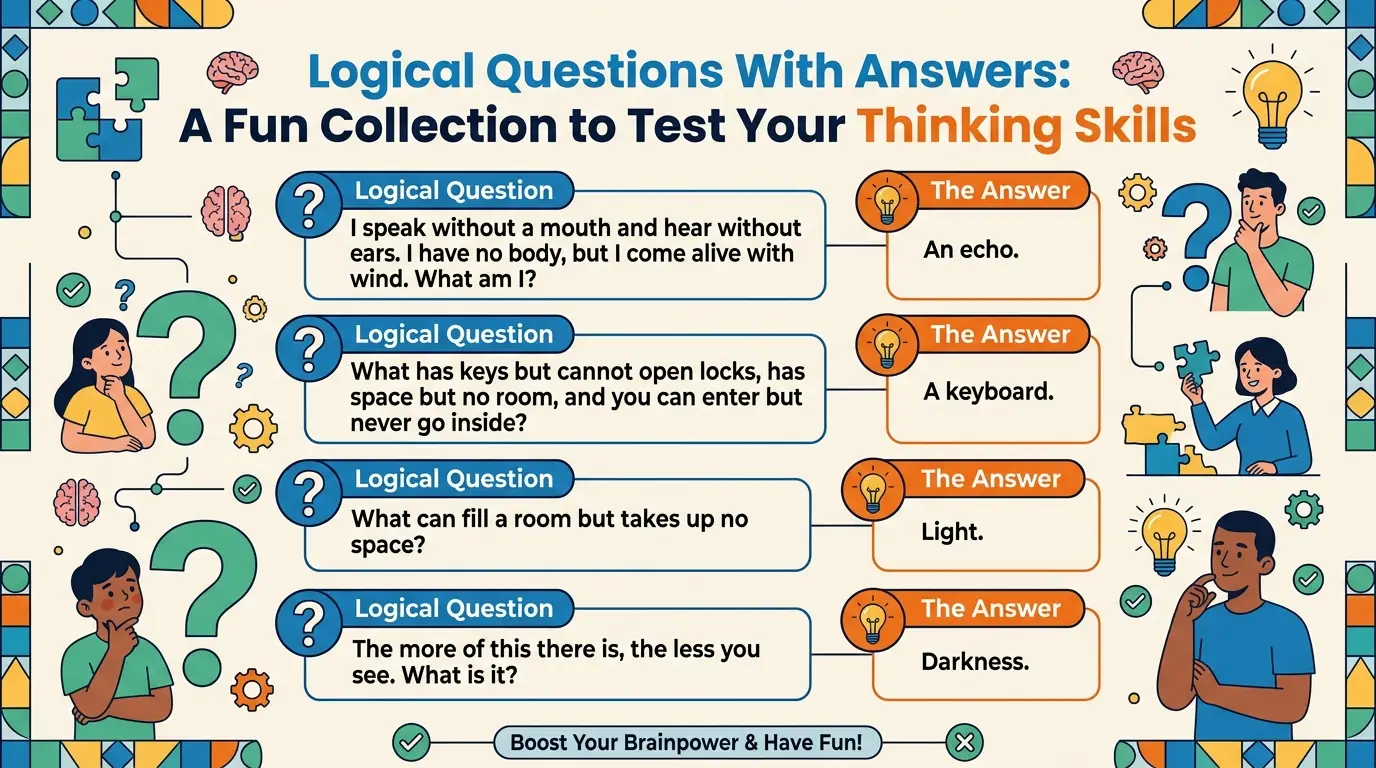
“What has keys but cannot open locks?”
Answer: A piano. It has keys, but those keys do not unlock doors.
“If you have one match and enter a dark room containing a candle, a lamp, and a fireplace, what do you light first?”
Answer: The match. You need to light the match before lighting anything else.
“What comes once in a minute, twice in a moment, but never in a thousand years?”
Answer: The letter “M.”
“Which is heavier: one kilogram of feathers or one kilogram of gold?”
Answer: Both weigh the same because they are both one kilogram.
“If a doctor gives you three pills and tells you to take one every 30 minutes, how long will they last?”
Answer: One hour. You take the first pill immediately, the second after 30 minutes, and the third after 60 minutes.
“What can travel around the world while staying in the same corner?”
Answer: A stamp.
“A rooster lays an egg on top of a roof. Which way does it roll?”
Answer: It does not roll because roosters do not lay eggs.
“What has a face and two hands but no arms or legs?”
Answer: A clock.
“If you throw a red stone into the blue sea, what will happen?”
Answer: The stone becomes wet.
Tricky Logical Questions With Answers
Some logical puzzles are designed to trick your brain. The answer often depends on carefully reading the question instead of rushing to conclusions.
“A man walks into a restaurant and asks for water. The waiter suddenly pulls out a gun. The man says thank you and leaves. Why?”
Answer: The man had hiccups. The waiter scared him, which cured the hiccups.
“You see a boat filled with people, but there is not a single person on the boat. How is that possible?”
Answer: Everyone on the boat is married. There is not a single person.
“A house has four walls, and all four walls face south. A bear walks by. What color is the bear?”
Answer: White. The house is at the North Pole, where polar bears live.
“How many months have 28 days?”
Answer: All 12 months have at least 28 days.
“A person was born in 2005 and died in 2005 at age 80. How is this possible?”
Answer: 2005 was the room number, not the year.
“What gets bigger the more you take away from it?”
Answer: A hole.
“A man shaves several times a day but still has a beard. Who is he?”
Answer: A barber. He shaves other people.
“What has many teeth but cannot bite?”
Answer: A comb.
“If there are three apples and you take away two, how many apples do you have?”
Answer: You have two apples because you took them.
“A woman has seven children, and each child has one brother. How many children are there?”
Answer: Eight children. The seven children share the same brother.
Fun Logical Questions With Answers For Friends
Logic games are perfect for parties, classrooms, and conversations with friends. These questions can create interesting discussions and friendly competitions.
“If five machines make five products in five minutes, how long will 100 machines take to make 100 products?”
Answer: Five minutes. Each machine makes one product in five minutes.
“You have a basket with five apples. You give one apple to each of five friends, but one apple remains in the basket. How?”
Answer: The last friend receives the basket with the apple inside.
“What disappears as soon as you say its name?”
Answer: Silence.
“A man is standing outside in the rain without an umbrella or hat, but his hair does not get wet. Why?”
Answer: He is bald.
“What belongs to you but other people use it more than you?”
Answer: Your name.
“A plane crashes on the border of two countries. Where do they bury the survivors?”
Answer: They do not bury survivors.
“If yesterday was tomorrow, today would be Friday. What day is today?”
Answer: Wednesday.
“What has a neck but no head?”
Answer: A bottle.
“What has an eye but cannot see?”
Answer: A needle.
“What can fill a room but takes up no space?”
Answer: Light.
Hard Logical Questions With Answers To Challenge Your Mind
If you enjoy difficult puzzles, these challenging logical questions with answers will push your reasoning skills further.
“There are three switches downstairs and one light bulb upstairs. You can only go upstairs once. How do you determine which switch controls the bulb?”
Answer: Turn on the first switch for a few minutes, turn it off, and turn on the second switch. Go upstairs. If the bulb is on, the second switch controls it. If it is off but warm, the first switch controls it. If it is off and cold, the third switch controls it.
“A father and son are in a car accident. The father dies. The boy is taken to the hospital. The surgeon says, ‘I cannot operate because he is my son.’ How is this possible?”
Answer: The surgeon is the boy’s mother.
“You have two ropes that each burn for one hour, but they do not burn evenly. How can you measure 45 minutes?”
Answer: Light one rope from both ends and the other from one end. When the first rope finishes, 30 minutes have passed. Light the second end of the second rope. It will burn for another 15 minutes.
“A person looks at a picture and says, ‘Brothers and sisters I have none, but this man’s father is my father’s son.’ Who is in the picture?”
Answer: His son.
“You have eight balls, and one is heavier. How can you find it using only two weighings?”
Answer: Divide the balls into groups of three, three, and two. Compare groups and continue narrowing down.
“A clock shows 3:15. What is the angle between the hour and minute hands?”
Answer: 7.5 degrees.
“A prisoner must choose between three rooms. One has fire, one has assassins, and one has lions that have not eaten for three years. Which room is safest?”
Answer: The room with the lions because they would have died after three years without food.
“Two fathers and two sons go fishing. They catch three fish, and each gets one fish. How?”
Answer: They are a grandfather, father, and son.
“A person enters a room with a match, a candle, and a lamp. What do they light first?”
Answer: The match.
“What number comes next: 2, 3, 5, 8, 13?”
Answer: 21. Each number is the sum of the previous two.
Logical Questions With Answers For Students
Students can use logic puzzles to improve reasoning skills and prepare for academic challenges.
“If all cats are animals and some animals are dogs, are all cats dogs?”
Answer: No. The information does not prove that.
“A train travels 60 miles in one hour. How far will it travel in three hours?”
Answer: 180 miles.
“If 10 people can build a wall in 10 days, how long will 5 people take?”
Answer: 20 days, assuming everyone works at the same speed.
“What number should replace the question mark: 5, 10, 20, 40, ?”
Answer: 80.
“If a triangle has three sides and a square has four sides, how many sides does a circle have?”
Answer: A circle has no straight sides.
“A book has 100 pages. How many digits are needed to number all pages?”
Answer: 192 digits.
“If one hand has five fingers, how many fingers do ten hands have?”
Answer: 50 fingers.
“A number multiplied by itself equals 49. What is the number?”
Answer: 7 or -7.
“What comes after 1, 11, 21, 1211?”
Answer: 111221.
“If today is Monday, what day will it be after 100 days?”
Answer: Wednesday.
More Logical Questions With Answers
“What has four legs in the morning, two legs during the day, and three legs in the evening?”
Answer: A human. This is the famous Sphinx riddle: crawling as a baby, walking as an adult, and using a cane as an elderly person.
“If a room has five candles and two go out, how many candles remain?”
Answer: Five candles remain, but two are no longer burning.
“What has words but never speaks?”
Answer: A book.
“What has a thumb and four fingers but is not alive?”
Answer: A glove.
“What can you catch but not throw?”
Answer: A cold.
“What has branches but no leaves, trunk, or fruit?”
Answer: A bank.
“What is full of holes but still holds water?”
Answer: A sponge.
“What goes up but never comes down?”
Answer: Your age.
“What has a bottom at the top?”
Answer: Your legs.
“What has one head, one foot, and four legs?”
Answer: A bed.
“A farmer has 10 cows. All but 3 escape from the field. How many cows are left?”
Answer: 3 cows are left because “all but 3” means 3 remained.
“What number has the same number of letters as its value?”
Answer: Four. The word “four” has four letters.
“If you multiply me by any number, the answer will always remain the same. What number am I?”
Answer: Zero. Any number multiplied by zero equals zero.
“A girl falls from a 20-foot ladder but is not hurt. Why?”
Answer: She fell from the bottom step.
“What can run but never walks, has a mouth but never talks, and has a bed but never sleeps?”
Answer: A river.
“If two is company and three is a crowd, what are four and five?”
Answer: Nine.
“A man travels around the world but stays in one spot. How?”
Answer: He is looking at a map or globe.
“What has a ring but no finger?”
Answer: A telephone.
“Which word becomes shorter when you add two letters to it?”
Answer: Short. Adding “er” makes “shorter.”
“What is always in front of you but cannot be seen?”
Answer: The future.
“A person has four daughters, and each daughter has a brother. How many children does the person have?”
Answer: Five children. The daughters share the same brother.
“What can you hold without ever touching it?”
Answer: A conversation or your breath.
“What has cities, rivers, and mountains but no houses, water, or trees?”
Answer: A map.
“A man was born in London but died in London. He was 50 years old when he died, but he only lived 10 years. How?”
Answer: He lived in a building called London.
“What number comes next: 1, 4, 9, 16, 25?”
Answer: 36. These are square numbers.
“If there are 6 eggs and you take away 2 eggs, how many eggs do you have?”
Answer: You have 2 eggs because you took them.
“What can be cracked, made, told, and played?”
Answer: A joke.
“What has an end but no beginning, a home but no family, and a space but no room?”
Answer: A keyboard.
“If a spider has 8 legs, how many legs do 3 spiders have?”
Answer: 24 legs.
“What gets wet while drying something else?”
Answer: A towel.
“A man has 12 socks in a drawer: 6 black and 6 white. How many socks must he pick to guarantee a matching pair?”
Answer: 3 socks. Two colors mean the third sock must match one of them.
“What is the next number: 10, 20, 30, 40, ?”
Answer: 50.
“What has a head and a tail but no body?”
Answer: A coin.
“A person has a clock that loses 10 minutes every hour. It shows the correct time at noon. When will it next show the correct time?”
Answer: After 72 hours, because it loses 12 hours over that period.
“If a rooster is standing on a roof facing east, which way will its shadow fall?”
Answer: Roosters do not create shadows in a direction-based answer without sunlight details, but the trick is that the rooster does not lay eggs or the question depends on conditions.
“What is so fragile that saying its name breaks it?”
Answer: Silence.
“A man has five daughters. Each daughter has a brother. How many children does he have?”
Answer: Six children.
“What has no beginning, end, or middle?”
Answer: A circle.
“If you have 3 boxes and each box contains 3 smaller boxes, how many boxes are there?”
Answer: 12 boxes.
“A person is running but never moves. How is that possible?”
Answer: They are running a race in a video game or on a treadmill.
“What comes down but never goes up?”
Answer: Rain.
“A house is one story high. Everything inside is blue. What color are the stairs?”
Answer: There are no stairs because it is a one-story house.
“What has many keys but cannot open a single lock?”
Answer: A computer keyboard.
“What can you see once in a year, twice in a week, but never in a day?”
Answer: The letter “E.”
“A clock strikes six times in five seconds. How long does it take to strike twelve times?”
Answer: 11 seconds. There are 5 intervals between 6 strikes, so each interval is 1 second.
“What has a heart that does not beat?”
Answer: An artichoke.
“If you have 5 oranges and take away 3, how many oranges do you have?”
Answer: 3 oranges.
“What is black when clean and white when dirty?”
Answer: A chalkboard.
“What has many pages but is not a book?”
Answer: A calendar.
“What has a tongue but cannot taste?”
Answer: A shoe.
“A man walks into a room and turns off a light. Later, many people die. Why?”
Answer: He turned off a lighthouse light, causing ships to crash.
“What can be measured but has no length, width, or height?”
Answer: Time.
“What has a face but no eyes, hands but no arms?”
Answer: A clock.
“If you have a matchbox with one match, and you enter a room with a fireplace, candle, and lamp, what do you light first?”
Answer: The match.
“What can you break without touching it?”
Answer: A promise.
“What has a beginning but no end?”
Answer: A road.
“What is always coming but never arrives?”
Answer: Tomorrow.
“A man has 2 coins that add up to 30 cents, but one of them is not a nickel. What are the coins?”
Answer: A quarter and a nickel. One coin is not a nickel, but the other one is.
“What has four wheels and flies?”
Answer: A garbage truck.
“A family has two parents and six sons. Each son has one sister. How many people are in the family?”
Answer: Nine people: two parents, six sons, and one daughter.
“What number is missing: 2, 6, 12, 20, ?”
Answer: 30. The pattern adds 4, 6, 8, and then 10.
“What can you serve but never eat?”
Answer: A tennis ball.
“A man stands in the rain for an hour without getting wet. Why?”
Answer: He was indoors watching the rain.
“What has a lot of eyes but cannot see?”
Answer: A potato.
“What is found in the middle of nowhere?”
Answer: The letter “H.”
“What can go through glass without breaking it?”
Answer: Light.
“What has one eye but cannot see and moves slowly?”
Answer: A needle.
“What is the smallest number that increases when turned upside down?”
Answer: 6 becomes 9.
“If 3 cats catch 3 mice in 3 minutes, how long will 100 cats take to catch 100 mice?”
Answer: 3 minutes.
“What has legs but cannot walk?”
Answer: A table.
“What starts with T, ends with T, and has T inside?”
Answer: A teapot.
“What has no life but can die?”
Answer: A battery.
“What can you keep after giving it to someone?”
Answer: Your word.
“A woman has one child, but that child has two parents. How?”
Answer: The child has a mother and father.
“What is the next number: 3, 6, 12, 24, ?”
Answer: 48.
“What has a face and hands but no arms or legs?”
Answer: A clock.
“What can you make that nobody can see?”
Answer: Noise.
“What is easy to lift but hard to throw?”
Answer: A feather.
“What goes through towns and over hills but never moves?”
Answer: A road.
“What has a head like a cat, feet like a cat, but is not a cat?”
Answer: A kitten.
“What has an ear but cannot hear?”
Answer: A corn plant.
“What can you never put in a saucepan?”
Answer: Its lid.
“What has 13 hearts but no organs?”
Answer: A deck of cards.
“What has a bottom at the top?”
Answer: Your legs.
“What is full of keys but opens no doors?”
Answer: A piano.
“What can be seen in water but never gets wet?”
Answer: A reflection.
“What is always running but never gets tired?”
Answer: Water.
“What has a neck but no head and wears a cap?”
Answer: A bottle.
“What can fly without wings and cry without eyes?”
Answer: A cloud.
“What has a thumb and fingers but is not alive?”
Answer: A glove.
“What has a bed but never sleeps?”
Answer: A river.
“What can you hear but cannot touch or see?”
Answer: Sound.
“What gets sharper the more you use it?”
Answer: Your brain.
“What has a spine but no bones?”
Answer: A book.
“What has many branches but no leaves?”
Answer: A bank.
“What goes around a yard but never moves?”
Answer: A fence.
“What has a face, hands, and numbers?”
Answer: A clock.
“What is always old but becomes new every day?”
Answer: A newspaper.
“What can be opened and closed but has no door?”
Answer: An eye.
“What has a tail and a head but no body?”
Answer: A coin.
“What can you catch but cannot throw?”
Answer: A cold.
“What has a ring but no finger?”
Answer: A phone.
“What is the only place where today comes before yesterday?”
Answer: A dictionary.
“What has a mouth but never eats?”
Answer: A river.
“What can be seen once in a moment, twice in a movement, but never in a thousand years?”
Answer: The letter “M.”