
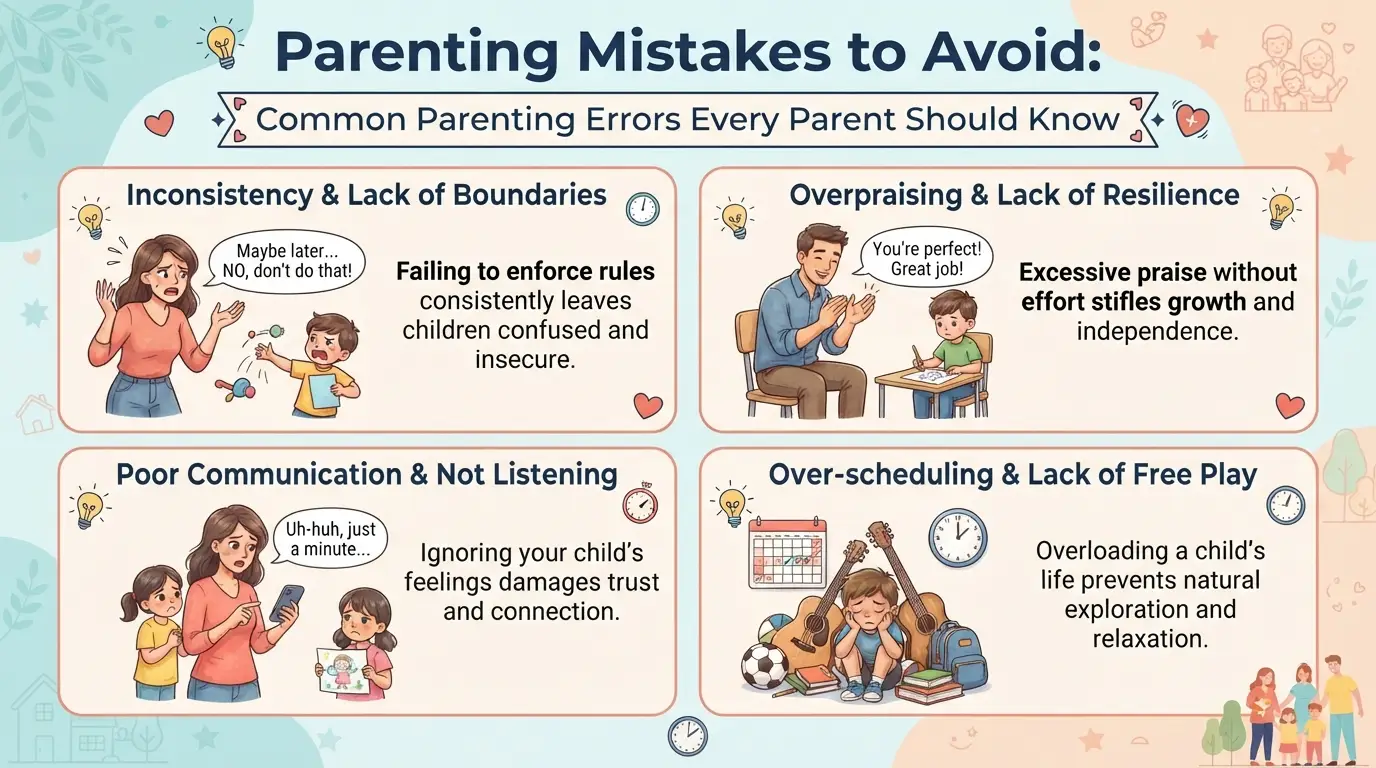
Parenting Mistakes to Avoid: Common Parenting Errors Every Parent Should Know
Parenting is one of the most rewarding journeys in life, but it can also be challenging, confusing, and exhausting. Every parent makes mistakes, and nobody gets everything right all the time. The goal isn’t to become a perfect parent. Instead, it’s about learning, adjusting, listening, and creating a healthy environment where children feel loved and supported. Knowing the common parenting mistakes to avoid can help you handle everyday situations with more patience and confidence.
Whether you are raising a toddler, school-age child, teenager, or young adult, these 99 parenting mistakes to avoid can help you build stronger relationships and encourage healthy emotional development.
Parenting Mistakes to Avoid With Communication
“Talking instead of listening” can become a common parenting mistake. Children need opportunities to express their feelings, thoughts, worries, and experiences without immediately being interrupted or corrected. Listening carefully shows your child that their voice matters.
“Constantly telling your child what to do” can create unnecessary resistance. Children need guidance, but they also need opportunities to make age-appropriate choices. Giving simple options can help them develop independence and confidence.
“Using sarcasm to correct behavior” is another parenting mistake to avoid. Adults may see sarcasm as harmless humor, but children can interpret it as criticism or embarrassment. Clear and respectful communication usually works better.
“Dismissive responses” can make children reluctant to share their feelings. Saying things like “you’re fine” or “it’s not a big deal” may unintentionally minimize their emotions. Instead, acknowledge what they are experiencing before helping them work through it.
“Expecting children to communicate like adults” is unrealistic. Young children may cry, yell, withdraw, or struggle to explain what they need. Parents can teach communication skills gradually rather than expecting perfect emotional expression.
Parenting Mistakes to Avoid With Discipline
“Disciplining while extremely angry” is one of the most important parenting mistakes to avoid. When emotions are running high, parents can say things they later regret. Taking a short pause can create enough space to respond calmly.
“Using physical punishment” can damage trust and does not teach children the skills they need to manage behavior. Discipline is more effective when it focuses on boundaries, consequences, teaching, and repair.
“Threatening consequences you don’t intend to enforce” can make rules feel meaningless. Children learn quickly when warnings are empty. Set realistic consequences and follow through consistently.
“Changing rules constantly” can confuse children. If a behavior is unacceptable one day but ignored the next, your child may struggle to understand expectations. Consistent boundaries make family life more predictable.
“Giving consequences without explaining expectations” is another mistake to avoid. Children need to understand what behavior was inappropriate and what they can do differently next time.
“Punishing normal childhood behavior” can create unnecessary conflict. Curiosity, occasional messiness, questions, mistakes, and emotional reactions are often part of growing up. Parents should distinguish between normal development and genuinely harmful behavior.
“Using shame as discipline” can hurt a child’s self-image. Correcting behavior is different from attacking someone’s character. Say, “That behavior wasn’t okay,” rather than making your child believe they are a bad person.
Parenting Mistakes to Avoid With Emotions
“Telling children not to cry” can teach them to hide emotions rather than understand them. Crying is a normal emotional response. Children can learn that feelings are acceptable while certain behaviors still require boundaries.
“Trying to solve every problem immediately” is another parenting mistake to avoid. Sometimes children need a listening ear more than a solution. Ask whether they want help, advice, or simply someone to listen.
“Expecting children to always be happy” creates unrealistic emotional expectations. Sadness, disappointment, anger, frustration, fear, and embarrassment are all part of life.
“Making children responsible for a parent’s emotions” can place an unfair emotional burden on them. Adults should manage their own emotional responsibilities while teaching children healthy emotional awareness.
“Comparing your child’s emotions with your own childhood” may cause them to feel misunderstood. Your experiences can provide perspective, but every child has a different personality and set of circumstances.
“Making fun of fears” can make children feel ashamed. Even when a fear seems unreasonable to an adult, it may feel very real to a child. Patience and reassurance can help them gradually develop confidence.
Parenting Mistakes to Avoid With Confidence
“Comparing siblings” is one of the parenting mistakes to avoid because it can create resentment and insecurity. Children should not feel that they are competing for parental approval.
“Comparing your child with classmates or friends” can also damage confidence. Every child develops at a different pace and has different strengths.
“Only praising achievements” can make children believe their value depends on performance. Recognizing effort, persistence, kindness, creativity, courage, and improvement is equally important.
“Labeling a child as lazy, difficult, shy, or naughty” can influence how they see themselves. Children often internalize repeated descriptions. Focus on specific behaviors rather than permanent labels.
“Expecting perfection” puts unnecessary pressure on children. Mistakes are an important part of learning. A child who knows they can make mistakes safely may become more willing to try challenging things.
“Speaking negatively about your child’s appearance” can affect body confidence. Children need to know that their worth is not determined by their weight, height, skin, clothing, or physical features.
“Taking credit for every success” can prevent children from recognizing their own abilities. Celebrate what they accomplished and help them understand the effort they contributed.
Parenting Mistakes to Avoid With Independence
“Doing everything for your child” may seem helpful, but it can prevent them from developing important life skills. Give children age-appropriate responsibilities such as organizing belongings, preparing simple meals, cleaning up, or managing school materials.
“Never allowing children to make mistakes” is another common parenting mistake. Safe mistakes can provide valuable lessons that lectures cannot.
“Making every decision for your child” can limit independence. Give children opportunities to choose clothing, hobbies, activities, books, or reasonable household responsibilities.
“Protecting children from every disappointment” can make ordinary setbacks feel overwhelming later. Children benefit from learning that disappointment is uncomfortable but manageable.
“Solving every conflict for your child” can prevent them from developing problem-solving skills. When appropriate, help them think through possible solutions rather than immediately taking over.
“Expecting independence before a child is ready” is equally problematic. Independence should develop gradually according to age, maturity, and circumstances.
Parenting Mistakes to Avoid at Home
“Creating unrealistic household expectations” can make daily life unnecessarily stressful. Children need clear responsibilities, but those expectations should match their age and abilities.
“Expecting children to keep everything perfectly clean” can lead to constant conflict. Teaching children to clean up is important, but homes with children will naturally experience some mess.
“Using chores only as punishment” can create negative attitudes toward responsibility. Chores can instead be presented as normal contributions to family life.
“Having completely different rules between parents” can confuse children. Parents do not have to agree on everything, but discussing important household expectations privately can create greater consistency.
“Arguing with your partner in front of children constantly” can make them feel insecure. Disagreements happen in families, but children benefit from seeing adults handle conflict respectfully and repair disagreements.
“Using children as messengers between adults” is another parenting mistake to avoid. Adult communication should remain an adult responsibility whenever possible.
Parenting Mistakes to Avoid With Technology
“Allowing unlimited screen time without boundaries” can interfere with sleep, responsibilities, family interaction, and physical activity. Technology works best when children have clear expectations around when and where devices can be used.
“Using screens as the only way to calm a child” can become a habit that makes other coping skills harder to develop. Screens can be useful, but children should also learn calming strategies that do not depend on devices.
“Giving children unrestricted internet access” can expose them to inappropriate content and online risks. Age-appropriate parental supervision and conversations about digital safety are important.
“Monitoring without explaining privacy boundaries” can create distrust. Children should understand that safety supervision is different from unnecessarily invading every aspect of their private life.
“Modeling excessive phone use” is one of the parenting mistakes to avoid. Children notice what adults do. If parents constantly check phones during conversations, children may learn that devices deserve more attention than people.
Parenting Mistakes to Avoid With School
“Focusing only on grades” can make education feel like a constant performance test. Learning, curiosity, effort, organization, creativity, and personal growth matter too.
“Doing your child’s homework for them” may produce a finished assignment but removes the opportunity to learn. Parents can provide guidance without taking over the work.
“Reacting harshly to poor grades” can make children afraid to discuss academic struggles. A low grade can be a starting point for understanding what went wrong and what support is needed.
“Assuming teachers are always wrong or always right” can create unnecessary problems. Parents should listen to their child while also gathering information from educators and looking at the situation fairly.
“Expecting every child to excel in the same subjects” ignores individual strengths. One child may love mathematics while another thrives in writing, music, sports, science, or creative activities.
“Overloading children with activities” can leave little time for rest or unstructured play. A busy schedule isn’t automatically a productive one.
Parenting Mistakes to Avoid With Relationships
“Forcing children to hug or kiss relatives” can teach them that they must ignore their personal boundaries to satisfy adults. Encourage respectful greetings while allowing reasonable choices about physical affection.
“Calling children ungrateful” can damage connection. Teach gratitude through example and conversation rather than making love conditional on appreciation.
“Using love as a bargaining tool” can create emotional insecurity. Children need to know that parental love remains present even when their behavior needs correction.
“Sharing embarrassing stories about children publicly” can make them feel exposed. Before posting stories or photographs online, consider whether your child would be comfortable with that information being shared.
“Reading private messages without a genuine safety reason” can damage trust. Parents should balance supervision with growing independence and have honest conversations about digital boundaries.
“Trying to control every friendship” can make children less likely to discuss relationships with you. Teach them how to recognize healthy and unhealthy friendships while remaining available for support.
Parenting Mistakes to Avoid With Routines
“Having no consistent bedtime routine” can make evenings chaotic. Children often benefit from predictable steps such as bathing, brushing teeth, reading, and winding down.
“Skipping family meals whenever possible” can mean losing valuable opportunities for conversation. Even a few shared meals each week can provide meaningful family connection.
“Over-scheduling every part of the day” can leave children exhausted. Downtime allows children to play, imagine, explore interests, and simply rest.
“Expecting children to transition instantly between activities” can cause unnecessary frustration. Giving advance warnings such as “five more minutes” can make transitions easier.
“Neglecting your own routine” can also affect family life. Parents need rest, organization, and personal time to function effectively. Self-care is not selfish when it helps you remain emotionally available.
Parenting Mistakes to Avoid as a Parent
“Trying to be a perfect parent” is perhaps one of the biggest parenting mistakes to avoid. Perfection is impossible, and chasing it can create unnecessary guilt.
“Refusing to apologize” can teach children that adults never need to admit mistakes. Saying “I’m sorry I yelled” demonstrates accountability and shows children how healthy repair works.
“Being afraid to change your parenting approach” can keep ineffective habits in place. As children grow, strategies often need to change.
“Following every parenting trend” can create confusion. Parenting advice should be considered thoughtfully rather than followed simply because it is popular online.
“Listening to too many outside opinions” can overwhelm parents. Friends, relatives, teachers, books, and online communities may offer useful perspectives, but parents still need to consider what fits their own family.
“Neglecting your own emotional needs” can contribute to burnout. Parents need reasonable opportunities for rest, support, hobbies, friendships, and recovery.
“Expecting yourself to know everything” is unnecessary. Asking for help is not a sign of failure. Parenting is a learning process, and seeking reliable support can be a strength.
More Parenting Mistakes to Avoid
“Making every conversation about behavior” can make children feel as though they are constantly being evaluated. Make space for jokes, stories, hobbies, dreams, and ordinary conversations.
“Interrupting children when they speak” can discourage open communication. Give them your attention when possible and allow them to finish their thoughts.
“Using too many rules” can make it difficult for children to understand which boundaries truly matter. Focus on a manageable number of important expectations.
“Making promises you cannot keep” can weaken trust. If circumstances change, explain honestly rather than repeatedly making commitments you cannot fulfill.
“Expecting children to read your mind” is unrealistic. Tell them clearly what you need, what you expect, and why the expectation matters.
“Using guilt to control behavior” can create unhealthy emotional patterns. Teach responsibility without making children believe they are responsible for everyone’s happiness.
“Focusing constantly on the future” can cause parents to overlook the present. Childhood passes quickly, so make room for ordinary moments, laughter, play, and connection.
“Trying to make your child exactly like you” ignores their individuality. Children are separate people with their own personalities, interests, strengths, and dreams.
“Treating every mistake as a crisis” can make family life unnecessarily stressful. Some mistakes require serious intervention, while others simply require correction and learning.
“Failing to celebrate small progress” can make growth feel invisible. Notice the little improvements, such as trying again, sharing, apologizing, waiting patiently, or handling frustration better.
“Believing one parenting strategy works for every child” is another important mistake to avoid. What works beautifully for one child may not work for another.
“Never changing your mind” can make parenting rigid. New information, changing circumstances, and your child’s development may require you to adjust your approach.
“Focusing only on obedience” can overlook important skills such as critical thinking, empathy, communication, and decision-making.
“Expecting children to manage adult responsibilities” can put unnecessary pressure on them. Children should contribute to family life without becoming responsible for problems that belong to adults.
“Neglecting affection” can make a busy household feel emotionally distant. Simple gestures such as hugs, encouraging words, smiles, and genuine attention can strengthen connection.
“Assuming your child knows you are proud of them” can mean missing opportunities to express encouragement. Tell them specifically what you appreciate about their effort or character.
“Only talking when something is wrong” can make children associate parental attention with criticism. Make positive conversations a normal part of family life.
“Refusing to accept that your child is growing up” can create unnecessary conflict. As children mature, parents need to gradually shift from direct control toward guidance and support.
“Trying to eliminate every risk” can prevent children from developing judgment. Age-appropriate freedom helps children learn how to assess situations and make responsible decisions.
“Expecting children to behave perfectly in public” can lead to unrealistic pressure. Children are still learning how to manage emotions, social situations, and impulses.
“Taking every disagreement personally” can make normal development feel like rejection. As children grow, they naturally begin to express different opinions and preferences.
“Not teaching children how to recover after failure” misses an important life lesson. Instead of focusing only on the mistake, help them identify what they learned and what they can try next.
“Making childhood entirely achievement-focused” can cause children to miss the value of curiosity and enjoyment. Childhood should include learning, but it should also include play and exploration.
“Failing to set boundaries because you want to be liked” can create confusion. Children need loving parents who can say no when necessary.
“Setting boundaries without warmth” can create unnecessary emotional distance. Firmness and affection can exist together.
“Trying to control every future outcome” can increase anxiety for both parents and children. Focus on the skills, values, and support your child needs today.
“Keeping children from seeing healthy vulnerability” can make emotions seem like weaknesses. Parents can model that it is okay to admit uncertainty, apologize, ask for help, and try again.
“Thinking one bad parenting day defines you” is another mistake worth avoiding. Every family has difficult days. What matters is the willingness to repair, learn, and keep moving forward.


